
Why Quick Service Restaurants in India Need Their Own Direct Ordering Channel


The Quick Service Restaurant, or QSR, industry in India has grown into one of the most competitive and fast-moving parts of the food business. From regional biryani chains to national burger and pizza brands, QSR outlets are opening in more cities, malls, and high streets every year. Customers today expect speed, consistency, and convenience, and most of them discover and order food through a mix of walk-ins, phone calls, and mobile apps.
For a long time, third-party delivery apps have been the easiest way for QSR brands to reach hungry customers. But as competition grows and margins tighten, many QSR owners and franchise operators are asking a simple question: who actually owns the relationship with the customer who just ordered a meal?
This blog looks at why that question matters, and how QSR chains can build a stronger, more direct connection with the people who eat their food every day.
The Growth Story of QSR in India
Industry reports have consistently pointed to the QSR segment as one of the fastest-growing categories within India's broader food services industry. Rising urban incomes, more working professionals, smaller family sizes, and a growing comfort with ordering food online have all contributed to this growth.
At the same time, this growth has attracted a large number of new brands and outlets, which means QSR chains today are competing not just on taste, but on how easily a customer can find them, order from them, and come back to them again. This is exactly where the choice of ordering channel starts to matter.
The Hidden Cost of Depending on Third-Party Apps
Third-party delivery apps undeniably helped many QSR brands get discovered by new customers, especially in the early growth phase. But as order volumes grow, so does the cost of staying dependent on them. Every order placed through an aggregator platform comes with a commission, and over time, this adds up to a meaningful share of revenue that could otherwise go back into the business.
Beyond cost, there is a bigger, quieter issue: customer data. When someone orders through a third-party app, the restaurant rarely gets to know who that customer is, what they like to order, or how often they come back. The relationship stays with the platform, not the brand. This makes it difficult for QSR chains to run their own loyalty programs, send personalised offers, or simply say thank you to a regular customer.
A Quick Comparison
Aspect | Third-Party Delivery Apps | Own Direct Ordering Channel |
Customer Data | Stays with the platform | Fully owned by your brand |
Commission on Orders | Typically high, cuts into margins | Meaningfully lower cost per order |
Repeat Customer Outreach | Limited or not possible | Direct offers, loyalty & reminders |
Menu & Pricing Control | Governed by platform rules | Full control, updated anytime |
Brand Visibility | Buried among competitors | Your outlet, your storefront |
Building a Direct Relationship With Every Customer
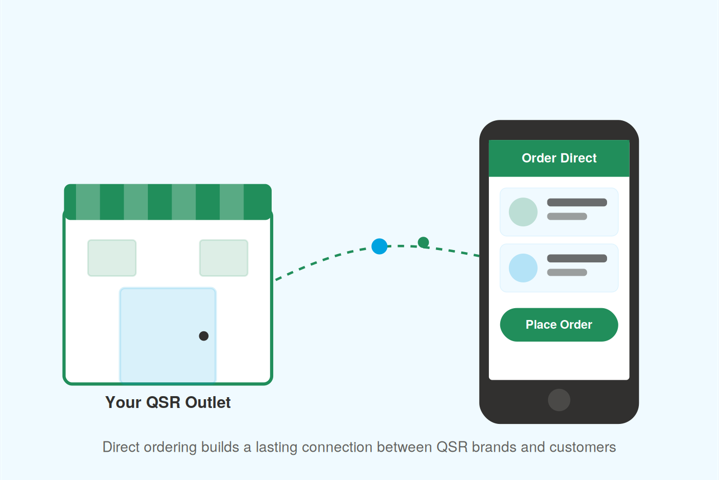
A direct ordering channel, whether it is a branded website, an app, or a WhatsApp-based ordering flow, changes this equation. Every order placed becomes a chance to learn something about the customer: their favourite items, their preferred outlet, how often they order, and what kind of offers get them to order again.
This is not just about saving on commission. It is about full customer ownership. When a QSR brand owns its customer data, it can run its own loyalty programs, plan festive or weekend campaigns, and build a genuine, lasting relationship with the people who keep the business running. Over time, this direct relationship tends to be more valuable than any single order, because it turns first-time customers into repeat customers.
The chart below illustrates, at a conceptual level, why brand teams increasingly see an owned ordering channel as a stronger long-term asset compared to being purely dependent on third-party apps.
Getting Started With a Direct Ordering Channel
Moving towards a direct ordering channel does not mean stepping away from delivery convenience. It means giving customers another, better way to order directly from the brand they already trust, while giving the QSR business full ownership of its own growth, data, and customer relationships.
For QSR chains and franchise operators evaluating their technology roadmap for the year ahead, this is a good moment to ask a simple question: how much of your customer relationship do you currently own, and how much of it sits with someone else's platform? Understanding the answer is often the first step towards building a stronger, more resilient QSR business.
ECommNxt works with QSR brands, restaurants, and hotel F&B teams across India to help them build exactly this kind of owned, direct ordering infrastructure, suited to how their outlets and franchises actually operate.


Comments